
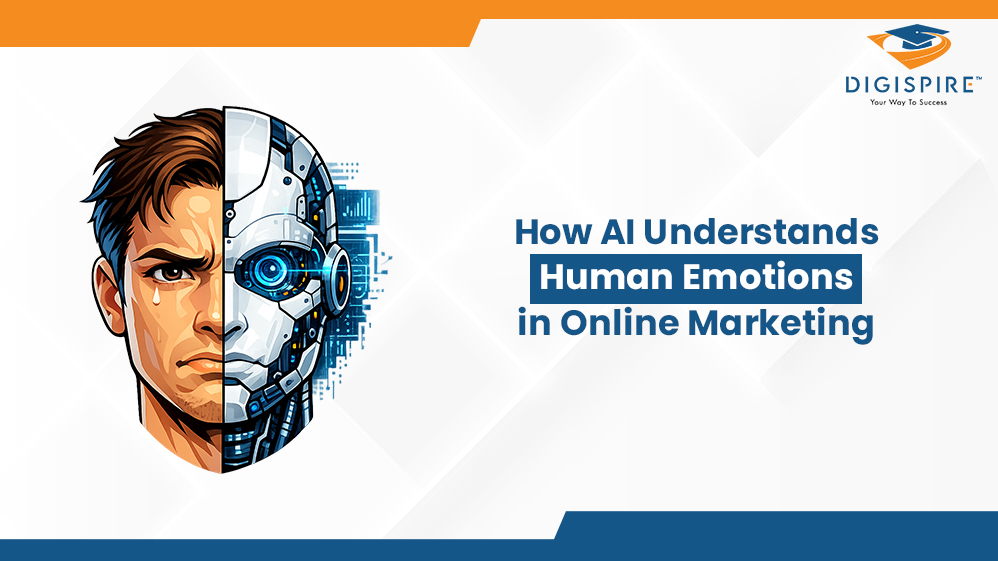
How AI Understands Human Emotions in Online Marketing

Table of Contents
Marketing today feels less like shouting into a crowded marketplace and more like reading the room. Brands are no longer depending only on assumptions to understand what customers want. Instead, they’re using artificial intelligence (AI) to identify emotions, behaviours, and reactions that influence buying decisions.
At Digispire Academy, we’ve seen how AI is reshaping online marketing by helping brands create experiences that feel more personal, relevant, and genuinely human. From analysing customer sentiments to predicting engagement patterns, AI is helping marketers connect with audiences on a deeper emotional level.
But how does AI actually understand emotions? And why is emotional intelligence becoming such a powerful tool in digital marketing? Let’s explore.
Why Emotions Matter in Consumer Behavior
People rarely make purchasing decisions based on logic alone. Emotions quietly influence what we click, share, trust, and ultimately buy.
Here’s why emotional intelligence matters in online marketing:
- Emotions influence buying decisions
Customers often choose products that “feel right” rather than those backed only by facts. - Emotional connections build loyalty
Brands that create meaningful emotional experiences enjoy stronger customer retention and repeat purchases. - Sentiments shape brand perception
A customer’s emotional experience with a brand often matters more than the product features themselves. - Emotion-driven content performs better
Content that sparks curiosity, joy, trust, or inspiration tends to receive higher engagement and conversions. - Emotional insights reveal market trends
Understanding audience sentiment helps brands predict changing consumer behaviour and preferences.
This is where AI-powered marketing becomes a game-changer.
How AI Detects and Understands Human Emotions
1. Sentiment Analysis Technology
AI uses Natural Language Processing (NLP) to study customer conversations across reviews, emails, comments, social media, and feedback forms. It identifies emotional patterns hidden within the language.
Modern AI tools can:
- Detect emotions like excitement, frustration, curiosity, trust, or skepticism
- Understand context, slang, sarcasm, and conversational tone
- Analyze customer sentiment in real time
- Process emotions across multiple languages and regions
Instead of simply labelling comments as “positive” or “negative”, AI now uncovers the emotional layers behind customer interactions.
2. Behavioral Pattern Recognition
AI also studies how people behave online, because actions often reveal emotions more clearly than words.
It analyses:
- Click ‘behaviour’ to understand interest levels
- Scroll patterns and page pauses to identify engagement
- Cart abandonment to detect hesitation or uncertainty
- Video watch time and replays to measure emotional impact
- Social media activity including emojis, hashtags, and shares
- Browsing flow to understand curiosity, confusion, or intent
Every click leaves behind a small emotional breadcrumb trail.
Practical Applications of Emotion AI in Online Marketing
Personalized Content Creation
AI helps brands create content tailored to emotional preferences instead of relying only on age or demographics.
For example:
- Some audiences connect with aspirational and success-driven messaging
- Others respond better to humor and light-hearted storytelling
- Some prefer emotionally meaningful or socially conscious campaigns
This allows marketers to deliver highly personalised experiences that feel authentic and relevant.
Predictive Customer Experience
AI can identify early signs of customer dissatisfaction before they leave a brand.
It helps businesses:
- Detect frustration in customer support conversations
- Identify declining engagement levels
- Predict churn risks
- Recommend proactive customer retention strategies
Instead of reacting late, brands can step in at the right moment with meaningful support.
Smarter Email Marketing
AI improves email marketing by understanding emotional timing and audience behaviour.
It can optimise:
- Best send times for engagement
- Emotion-driven subject lines
- Personalized messaging tone
- Customer journey-based communication
A well-timed email often feels less like marketing and more like a conversation arriving at exactly the right moment.
Social Media & Community Management
Emotion AI is transforming social media marketing by helping brands listen more carefully to their communities.
AI tools can:
- Detect unhappy customers quickly
- Identify loyal brand advocates
- Analyze audience sentiment trends
- Suggest the best posting times
- Monitor competitor perception gaps
This creates faster, smarter, and more empathetic customer engagement.
Video & Visual Content Optimization
Modern AI can even analyse emotional reactions to visual content.
It studies:
- Facial expressions
- Voice tone
- Viewer engagement patterns
- Visual attention areas
- Emotional responses to thumbnails or scenes
This helps brands create videos and campaigns that resonate emotionally with audiences.

The Digispire Academy Advantage
At Digispire Academy, we believe the future of online marketing lies in combining technology with human understanding. That’s why our digital marketing training focuses on emotion-aware AI strategies and practical industry skills.
Our learners gain expertise in:
- Sentiment analysis and consumer psychology
- AI-powered content personalization
- Emotional buyer persona development
- Ethical data-driven marketing
- Behavioral analytics and engagement tracking
- Creating emotionally compelling campaigns
In today’s digital world, marketers who understand emotions stand out from those who only understand algorithms.
Challenges & Ethical Considerations
While emotion AI offers powerful opportunities, it also comes with responsibilities.
Some key concerns include:
- Privacy & data transparency
Customers should know how their emotional data is being used. - Cultural differences
Emotional expressions vary across languages and cultures. - Algorithm bias
AI trained on limited datasets may misinterpret emotions. - Over-personalization
Excessive targeting can feel invasive rather than helpful. - Misinterpretation risks
Sarcasm, mixed emotions, and context remain challenging for AI.
Responsible digital marketing means using AI ethically, transparently, and with genuine customer benefit in mind.
The Future of Emotion AI in Marketing
The future of AI-driven marketing is becoming increasingly emotion-aware. Emerging technologies are already moving toward:
- Voice emotion recognition
- AI-powered customer support escalation
- Predictive emotional journeys
- Biometric and eye-tracking insights
- Augmented reality personalization
- Advanced neuromarketing strategies
Marketing is evolving from simply reaching people to truly understanding them.
Conclusion
AI’s ability to understand human emotions is transforming the future of online marketing. By combining emotional intelligence with data-driven strategies, brands can create stronger relationships, better customer experiences, and more meaningful engagement.
The future belongs to brands that don’t just market products but understand people behind the screens.
At Digispire Academy, we help aspiring marketers learn how to use AI-powered marketing tools ethically, creatively, and effectively in the ever-evolving digital landscape.
FAQs
AI identifies emotional patterns through language, behaviour, and engagement data. While it doesn’t “feel” emotions like humans do, it can predict emotional responses with impressive accuracy.
Yes, when used responsibly. Ethical emotion-based marketing focuses on improving customer experiences rather than manipulating decisions. Transparency and customer trust are essential.
E-commerce, SaaS, healthcare apps, entertainment, luxury brands, and customer service-driven businesses benefit significantly from emotion-aware AI strategies.
Responsible AI platforms follow privacy regulations like GDPR, use anonymised data, and allow users to opt out of emotional data tracking.
No. Many modern AI-powered marketing tools are beginner-friendly and designed for marketers without technical backgrounds. Understanding strategy and emotional intelligence matters more than coding expertise.