
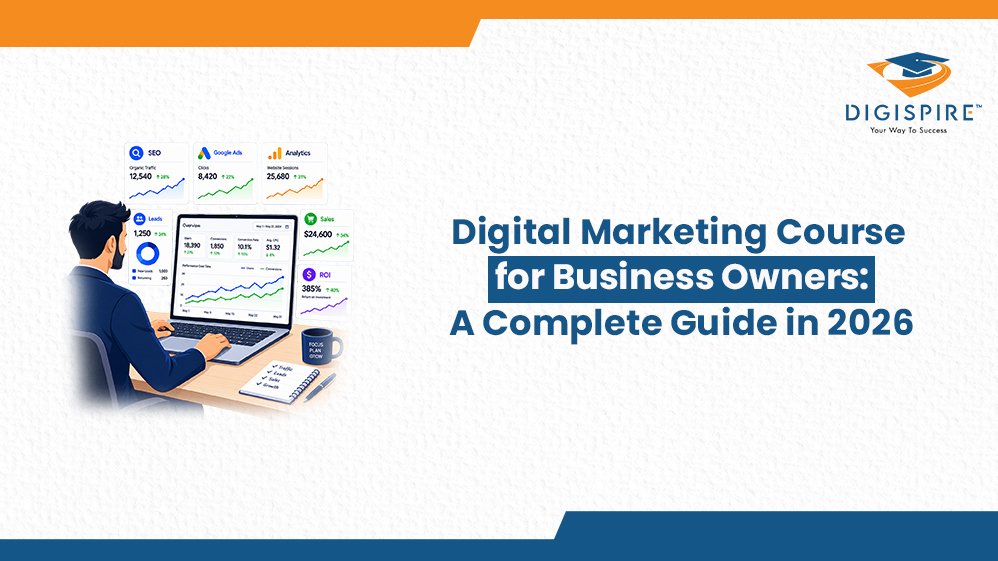
Digital Marketing Course for Business Owners: A Complete Guide in 2026
Table of Contents

Running a business in 2026 means wearing many hats. But there is one area business owners can no longer afford to leave entirely to someone else: online marketing.
Customers discover brands, compare options, read reviews and make buying decisions online. Digital marketing is no longer a “nice-to-have”; it is a practical business skill.
A structured digital marketing course for business owners can help entrepreneurs understand what happens behind campaigns, make smarter decisions and build a stronger digital presence without becoming full-time marketers.
Why Business Owners Need to Understand Digital Marketing
The business environment has changed. Online channels now influence how customers discover, evaluate and choose products and services. Understanding them helps owners make clearer decisions.
Without that understanding, businesses may face the following:
- Revenue leakage: Competitors reach potential customers first.
- Wasted marketing budgets: Campaigns may be approved without understanding performance.
- Brand invisibility: Customers may struggle to find the business on relevant platforms.
- Competitive disadvantage: Digitally confident competitors can build stronger customer relationships.
- Employee retention challenges: Outdated marketing can make a business appear disconnected from changing technology.
- Missed market opportunities: Customer and competitor insights may go unnoticed.
Learning online marketing does not mean doing every task yourself. It means knowing enough to ask better questions, identify opportunities and understand whether marketing efforts are actually moving the business forward.

What Should a Business Owner Learn?
Business owners do not need to become experts in every technical tool. They need a practical understanding of the areas that directly influence business growth.
1. Digital Strategy and Business Alignment
A strong strategy begins with the business, not the platform.
A good course should help owners understand:
- How customers move from discovery to purchase.
- How to identify target audiences and market gaps.
- How to choose channels according to business goals.
- How to allocate marketing budgets based on priorities and performance.
- How to set meaningful KPIs and measure progress.
This knowledge helps prevent the common mistake of choosing a platform simply because everyone else is using it.
2. Search and Content Visibility
Being present online is not enough. Customers need to be able to find you.
Business owners should understand the basics of the following:
- SEO and how search engines discover and rank content.
- Content marketing and how useful content builds trust.
- Paid search and how advertising can bring qualified traffic.
- Local search for businesses serving specific locations.
- Website fundamentals such as page speed, mobile optimisation and basic architecture.
You do not need to do every task yourself. You do need to recognise good work.
3. Social Media and Community Building
Social platforms are not simply places to post promotional graphics. They are spaces where customers discover brands, form opinions and build relationships.
A business-focused course should cover:
- Platform-specific approaches for Facebook, Instagram, LinkedIn, TikTok and emerging platforms.
- Audience engagement and community building.
- Influencer and creator collaborations.
- Crisis communication and reputation management.
- Social analytics and audience behaviour.
The goal is not to chase every trend. Digital marketing should help you understand which conversations matter and where your brand should participate.
4. Data Analytics and Business Intelligence
Numbers can tell a very different story from likes and comments.
Owners should learn how to understand:
- Conversion funnels and where potential customers drop off.
- Attribution and the touchpoints contributing to business results.
- Predictive analytics for identifying patterns and future opportunities.
- A/B testing for improving campaigns systematically.
- Dashboards that make important business metrics easier to monitor.
Reading performance data makes decisions less dependent on guesswork.
5. Email and Automation
Customer relationships should not end after the first purchase.
A practical course should introduce the following:
- List building and audience segmentation.
- Email campaigns and lead nurturing.
- Marketing automation for personalised communication at scale.
- Compliance and deliverability basics.
- ROI measurement for email activities.
These skills help businesses stay connected while reducing repetitive work.
Why Invest in a Digital Marketing Course?
For a business owner, education should lead to better decisions. That is where a digital marketing course for business owners becomes valuable.
It can help you:
- Make better hiring decisions: Understand what skills to look for when building an internal team.
- Manage agencies and vendors: Evaluate proposals, campaign performance and service quality more confidently.
- Reduce unnecessary spending: Spot inefficient activities before they consume more of your budget.
- Understand competitors: Use digital insights to study positioning, communication and market opportunities.
- Improve customer acquisition: Identify channels and conversion opportunities that can support growth.
- Strengthen business value: Well-structured marketing systems can contribute to a more mature and scalable operation.
- Empower your team: When owners understand strategy, they can communicate goals more clearly and support better execution.
The real advantage is informed decision-making.
How to Choose the Right Course
Not every programme is designed with business owners in mind. Look beyond the title and examine what you will actually learn.
Look for:
- Credible instructors: Practitioners with business or senior marketing experience can bring real-world context.
- Relevant curriculum: The syllabus should reflect current tools, platforms and customer behaviour.
- Practical learning: Case studies, simulations, projects and actionable exercises are more useful than theory alone.
- Peer community: Peer connections can create networking opportunities.
- Learning support: Live sessions, doubt resolution and instructor access can make the learning process easier.
- Flexible delivery: Online, self-paced or hybrid formats can work better around business responsibilities.
- Useful certification: A recognised credential can add professional credibility.
- Ongoing access: Continued access to resources can be helpful when you begin applying what you learnt.
The right course should feel connected to your business reality.
Common Misconceptions Business Owners Should Leave Behind
Several assumptions can make digital growth harder than it needs to be.
- “Digital marketing works overnight.” Sustainable results usually require consistency, testing and time.
- “More advertising means better results.” Targeting, positioning and message quality matter as much as budget.
- “One strategy works for every business.” Industry, audience, location and competition all influence the right approach.
- “Viral content automatically means business success.” High engagement does not always translate into sales or customer loyalty.
- “DIY is always better than agency support.” Some tasks can be handled internally, while complex initiatives may need specialised expertise.
- “Analytics are optional.” Data helps owners replace assumptions with evidence.
- “Only customer acquisition matters.” Retention, repeat purchases and referrals can be equally important for long-term value.

Why Digispire Academy?
Digispire Academy stands as Kolkata’s premier digital marketing institute, focused on helping learners develop practical, industry-relevant skills. For business owners, the learning journey can be especially valuable when it connects marketing concepts with real business decisions.
The academy’s approach includes the following:
- Owner-focused learning: Concepts are approached from a decision-maker’s perspective rather than only from an implementer’s point of view.
- Expert instruction: Lessons are shaped by practitioners with business and senior leadership experience.
- Hands-on projects: Business simulations and case studies make concepts easier to connect with real situations.
- Peer community: Learners can build professional connections with others on a similar journey.
- Flexible learning: Online and hybrid formats can accommodate demanding schedules.
- Ongoing support: Resources, alumni access and refresher sessions support continued learning.
For an entrepreneur, the goal is not simply another certificate. It is understanding the digital side of the business well enough to make sharper decisions and spot opportunities earlier.
Final Thoughts
The customer journey rarely follows a straight line. A person may see a social post, search for the brand, compare competitors and finally purchase after reading a review. Owners who understand this journey can build strategies around real customer behaviour.
A digital marketing course for business owners can provide the structure needed to understand these moving parts without becoming full-time specialists. With the right learning, owners can communicate better with marketing teams, manage budgets intelligently, evaluate vendors confidently and build a stronger foundation for sustainable growth.
At Digispire Academy, the focus is on turning learning into practical capability. If you are ready to understand the digital side of your business more clearly, explore the digital marketing course for business owners and take the next step towards becoming a more confident digital decision-maker.
FAQs
Most comprehensive programmes require around 40–80 hours, spread across 8–12 weeks depending on the learning format.
No. A course provides knowledge and frameworks, while results depend on how consistently and effectively you apply them.
Not at all. Established businesses can combine existing experience with new digital knowledge to identify practical opportunities.
Yes. Practical programmes help business owners identify opportunities and apply relevant concepts to their current operations.
Results vary, but better campaign efficiency, smarter hiring and stronger marketing decisions can help recover the learning investment over time.