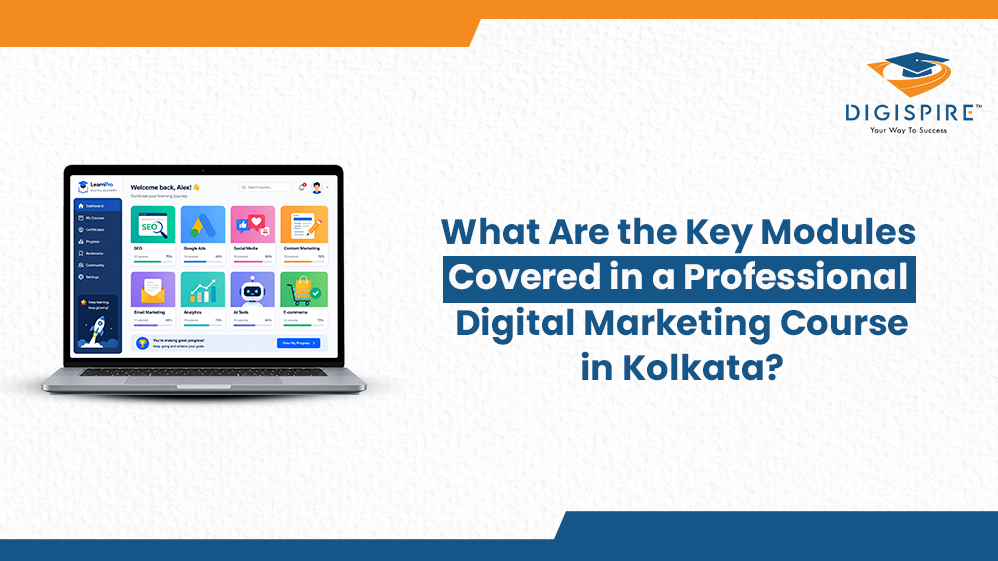
What Are the Key Modules Covered in a Professional Digital Marketing Course in Kolkata?

Table of Contents
Digital marketing is no longer just a trending career choice. It has become one of the most valuable skills for professionals, entrepreneurs, students, and freelancers alike. As more businesses move online, the demand for trained digital marketers continues to grow, creating exciting career opportunities across industries.
If you’re planning to build a career in this field, choosing the right digital marketing course in Kolkata is one of the most important decisions you’ll make. While many institutes offer similar promises, the curriculum often determines how well prepared you’ll be for real-world challenges.
A professional course should go beyond classroom lectures. It should combine strong conceptual knowledge with practical training, industry tools, live projects, and exposure to the latest marketing trends. Let’s explore the essential modules that every comprehensive digital marketing programme should include.
Why the Course Curriculum Matters
Not every course delivers the same learning experience. Some focus heavily on theory, while others provide the practical exposure that employers actually look for.
Before enrolling in a digital marketing course in Kolkata, take a close look at what you’ll actually learn throughout the programme.
A well-designed curriculum should include:
- A healthy balance between theory and practical implementation
- Hands-on experience with industry-standard marketing tools
- Regular updates based on changing search engine algorithms and platform trends
- Live projects or real business case studies
- Portfolio-building opportunities
- Career guidance and interview preparation
Learning digital marketing is not just about understanding concepts. It’s about applying those concepts to real campaigns, analysing results, and continuously improving performance.

Core Modules Covered in a Professional Digital Marketing Course
A complete digital marketing course in Kolkata generally covers multiple specialisations that work together to create successful online marketing strategies.
1. Search Engine Optimization (SEO)
SEO forms the foundation of digital marketing. It focuses on improving a website’s visibility on search engines through organic methods.
Students typically learn:
- On-page SEO techniques
- Off-page SEO strategies
- Keyword research and competitor analysis
- Technical SEO basics such as site speed, crawlability, and website structure
- Content optimisation for better rankings
- Local SEO strategies for businesses targeting nearby customers
A strong understanding of SEO helps marketers generate long-term traffic without relying entirely on paid advertisements.
2. Search Engine Marketing (SEM) and Paid Advertising
Paid advertising enables businesses to reach their audience quickly and effectively.
This module generally includes:
- Basics of paid advertising platforms
- Campaign setup and management
- Budget planning
- Bid strategy fundamentals
- Audience targeting and segmentation
- Writing effective ad copies
- A/B testing for better campaign performance
- Campaign optimisation and reporting
Understanding paid advertising allows marketers to generate measurable business results within shorter timeframes.
3. Social Media Marketing
Social media has become one of the most powerful channels for customer engagement and brand awareness.
Students usually learn:
- Platform-specific marketing strategies
- Content planning and scheduling
- Community management
- Audience engagement techniques
- Organic growth strategies
- Paid social advertising basics
- Social media analytics and performance tracking
The goal is to understand how different platforms serve different business objectives while maintaining a consistent brand voice.
4. Content Marketing
Content remains one of the strongest drivers of digital success.
This module focuses on creating valuable content that attracts, informs, and converts audiences.
Topics generally include:
- Content strategy planning
- Blog writing
- Website content creation
- Long-form articles
- Storytelling for brands
- Content repurposing
- Content distribution across multiple channels
Students also learn how quality content supports SEO, social media, and lead generation.
5. Email Marketing and Automation
Despite the rise of social media, email marketing continues to deliver excellent returns when used effectively.
A professional curriculum usually covers:
- Building email subscriber lists
- Audience segmentation
- Creating engaging email campaigns
- Automation workflows
- A/B testing subject lines and content
- Performance measurement
- Optimisation techniques
Understanding customer journeys and personalised communication forms an important part of this module.
6. Analytics and Data Interpretation
Successful marketing decisions rely on accurate data rather than assumptions.
Students are introduced to:
- Website traffic analysis
- User behaviour tracking
- Analytics dashboard setup
- Conversion tracking
- Campaign performance evaluation
- Reporting for clients and stakeholders
- Data-driven decision-making
Learning analytics helps marketers understand what works, what doesn’t, and where improvements are needed.
7. Emerging Digital Marketing Trends
Digital marketing evolves rapidly, making continuous learning essential.
Modern courses often introduce students to:
- AI tools for marketing workflows
- Voice search optimisation
- Conversational marketing
- Influencer marketing basics
- Video marketing strategies
- Changing consumer behaviour
- Future digital marketing trends
These topics help learners stay competitive in an industry that changes almost every year.

Why Practical Training Makes the Difference
Understanding concepts is important, but applying them is where real learning happens.
A quality digital marketing course in Kolkata should provide plenty of opportunities to practise through real scenarios rather than relying only on lectures.
Look for programmes that include the following:
- Live project experience
- Practical assignments
- Industry-standard tool training
- Website optimisation exercises
- Campaign creation practice
- Portfolio development
- Mock interviews and career preparation
Working on projects allows students to build confidence while developing skills employers expect from fresh candidates.

Who Can Benefit from a Digital Marketing Course?
One of the biggest advantages of digital marketing is that it welcomes learners from different educational and professional backgrounds.
This type of course is ideal for:
- Fresh graduates starting their careers
- Working professionals planning a career switch
- Entrepreneurs managing their own businesses
- Freelancers looking to expand their services
- Small business owners
- Anyone interested in building a professional online presence
Since businesses of every size rely on digital platforms, these skills remain valuable across industries.
How to Choose the Right Institute
Selecting the right training institute can have a significant impact on your learning experience and future opportunities.
Before making a decision, consider factors such as:
- Curriculum depth and industry relevance
- Practical training opportunities
- Trainer expertise and experience
- Access to live projects
- Placement assistance
- Career mentorship
- Learning environment
- Student support after course completion
A structured learning approach often helps students build stronger confidence while entering the job market.
Learn Digital Marketing with Digispire Academy
If you’re looking for practical learning with an industry-focused approach, Digispire Academy offers a comprehensive learning experience designed to prepare students for real-world digital marketing careers.
The curriculum covers every essential area, including SEO, paid advertising, social media marketing, content marketing, analytics, email marketing, and emerging digital trends. Alongside classroom learning, students gain valuable practical exposure through live projects, assignments, and hands-on training using professional tools.
Whether you’re a student exploring career opportunities, a working professional planning a transition, or an entrepreneur wanting to grow your business online, Digispire Academy provides the guidance, mentorship, and structured learning needed to build a strong foundation in digital marketing.
If you’re ready to begin your journey, choosing the right digital marketing institute can be the first step toward building a rewarding and future-ready career.
FAQs
Most courses cover SEO, SEM, social media marketing, content marketing, email marketing, and analytics along with practical training.
No. Professional courses are designed for beginners as well as working professionals looking to upskill.
Yes. A good programme includes live projects, tool-based training, assignments, and real-world case studies.
The duration depends on the institute and curriculum, ranging from a few weeks to several months.
Absolutely. It helps business owners understand digital marketing strategies and manage their online presence more effectively.